
How to reply when plans change at the last minute
In this guide
"Can you have the kids tomorrow instead?" "I'll be two hours late." "Saturday isn't going to work." Last-minute changes are one of the most common sources of friction between co-parents, and they rarely arrive at a good time.
Your reply matters more than it seems. It decides whether the change gets sorted in two messages or twenty, and it becomes part of the record. If anyone ever looks back at how arrangements were handled, a short, polite reply reads well. An angry one doesn't, however justified it felt at the time.
This guide covers a simple way to reply, examples you can adapt, what to do when the changes keep coming, and how Clarity Witness helps with each.
Before you reply, ask yourself
- Does this message need an answer at all?
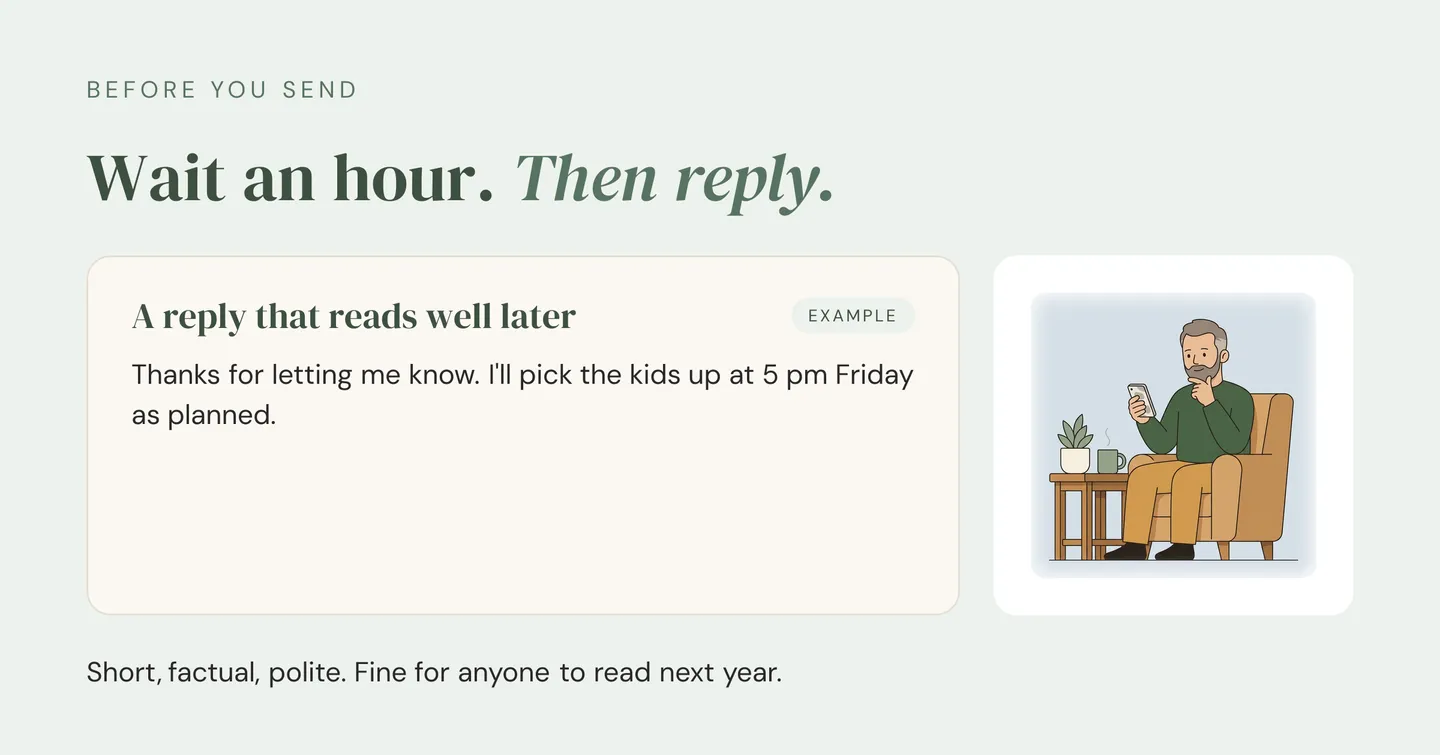
- Does it need one right now, or can it wait an hour?
- What's the one practical thing I need to say?
- Would I be fine with an attorney or a mediator reading this later?
That last one is a good filter. If the answer is no, it's worth another draft.
In Clarity Witness: run a tone check on your reply before you send it. It shows how the message might come across, which is exactly the question you're asking yourself, answered in a few seconds.
Brief, informative, friendly, firm
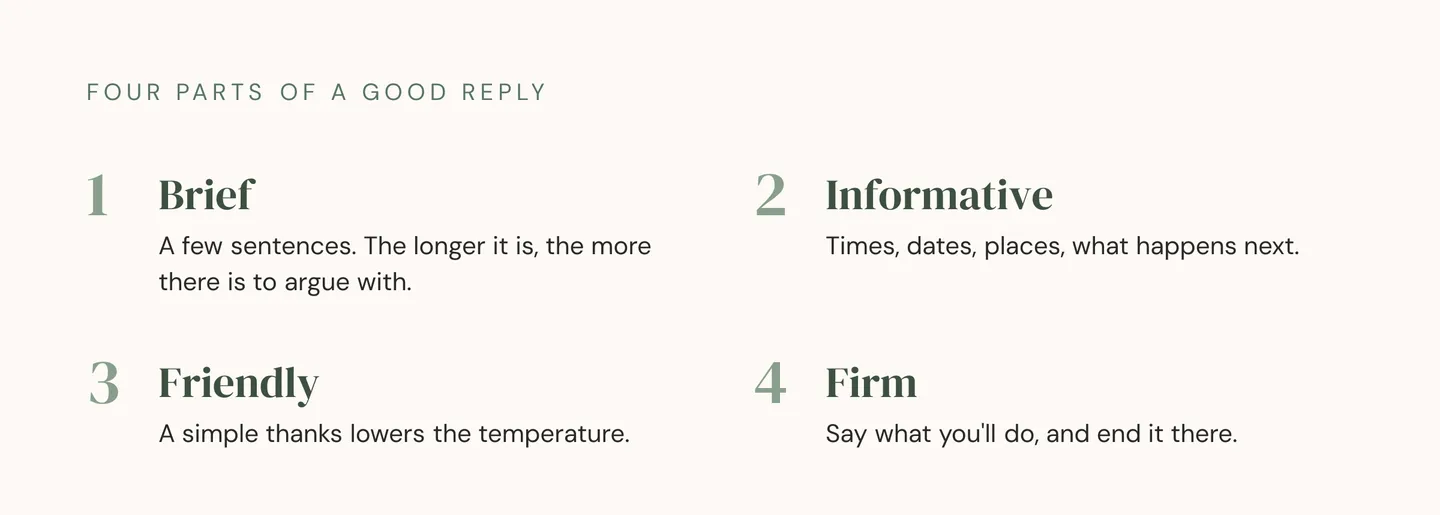
A structure many co-parenting counselors teach is the BIFF Response®, developed by Bill Eddy at the High Conflict Institute. It works well for last-minute changes:
- Brief - a few sentences. The longer the reply, the more there is to argue with.
- Informative - stick to facts. Times, dates, places, what happens next.
- Friendly - a simple "Thanks for letting me know" lowers the temperature.
- Firm - be clear about what you'll do, and end the conversation there.
Firm doesn't mean cold. It just means the reply doesn't leave the door open to another round of back and forth.
Examples you can adapt
These are examples, not scripts. Change the details to fit your situation.
When they ask to swap at short notice, and you can't:
When they say they'll be late:
When they cancel your time:
When you're happy to agree:
When they ask for something outside the plan:
When the request comes with a dig attached:
That last one ignores everything except the practical part. That's on purpose - more on it below.
In Clarity Witness: messages in the Clarity Witness co-parenting chat are dated and can't be edited or deleted once they're sent. That's good for you, because there's one clear version of what was agreed. It's also a reason to take that extra minute before you press send.
What to avoid
- Replying while angry. If a message makes your heart race, wait. Most changes don't need an answer within minutes.
- Long explanations. You don't need to justify following the plan you both agreed to.
- Bringing up the past. "This is the third time this month" belongs in your notes, not in your reply.
- Sarcasm and point-scoring. It rarely reads well later, to anyone.
- Using the kids as messengers. Every arrangement stays between the adults.
- Replying on several channels at once. Keep arrangements in one place, in writing.
When a message is designed to provoke
Some messages mix a practical question with criticism, blame or something that isn't true. It's natural to want to correct the record. Usually it's better not to.
Answer the practical part only and leave the rest. This is sometimes called the grey rock approach: you stay polite, brief and uninteresting, and there's nothing to push against. If a message has no practical question in it at all, you don't have to reply.
If something in a message really does need correcting - say it misstates the schedule - correct the fact in one line and move on. Arguments by text almost never end with anyone changing their mind.
In Clarity Witness: if you want something on record without replying, log it on your timeline instead. It's dated, it's private, and it doesn't start another round.
When the changes keep happening
One late change is life. Everyone gets stuck at work or has a sick kid sometimes. When changes become a pattern, it's worth handling differently.
Start by writing each one down: the date, what changed, when you were told and how. After a few weeks you'll be able to see whether it's occasional or constant, and whether it's falling on particular days.
If it's a real pattern, a few things can help:
- Agree a notice period in writing, for example 48 hours for anything other than an emergency
- Agree how missed time gets made up, so it's not argued about every time
- Ask your attorney or mediator whether your parenting plan should be updated
A dated record makes those conversations much easier. "It happens all the time" invites an argument. "Eleven changes since August, nine with less than a day's notice" doesn't.
In Clarity Witness: you don't have to count it up yourself. Witness reads your messages and entries together and points out patterns like how often plans change and how much notice you get. Briefings that lay it out clearly for your attorney or mediator are coming soon.
Keep the kids out of the uncertainty
Kids feel the disappointment of plans that fall through. Where you can, don't tell them about plans until they're confirmed. If something does change at the last minute, keep the explanation simple and neutral: "Plans have changed, so you'll see Dad on Sunday instead." They don't need to know whose fault it was.
Questions parents ask
Should I just agree to changes to keep the peace? Sometimes that's the right call, and flexibility is good for kids. But if agreeing means you're always the one giving way, or the kids miss out on time with you, it's fine to say no politely and keep to the plan.
Do I have to reply at night or at weekends? Not unless it's urgent and about the kids. You can agree reply times for routine messages, such as within 24 hours, and stick to them.
What if they reply with a long, angry message? You don't have to match it. Pick out any practical question and answer that. If there isn't one, it's fine to leave it.
What if the change is a real emergency? Be kind and practical. Emergencies happen. Agree the new plan, write it down, and leave it at that.