

Co-parenting with a narcissist: what actually helps
In this guide
- What it often looks like
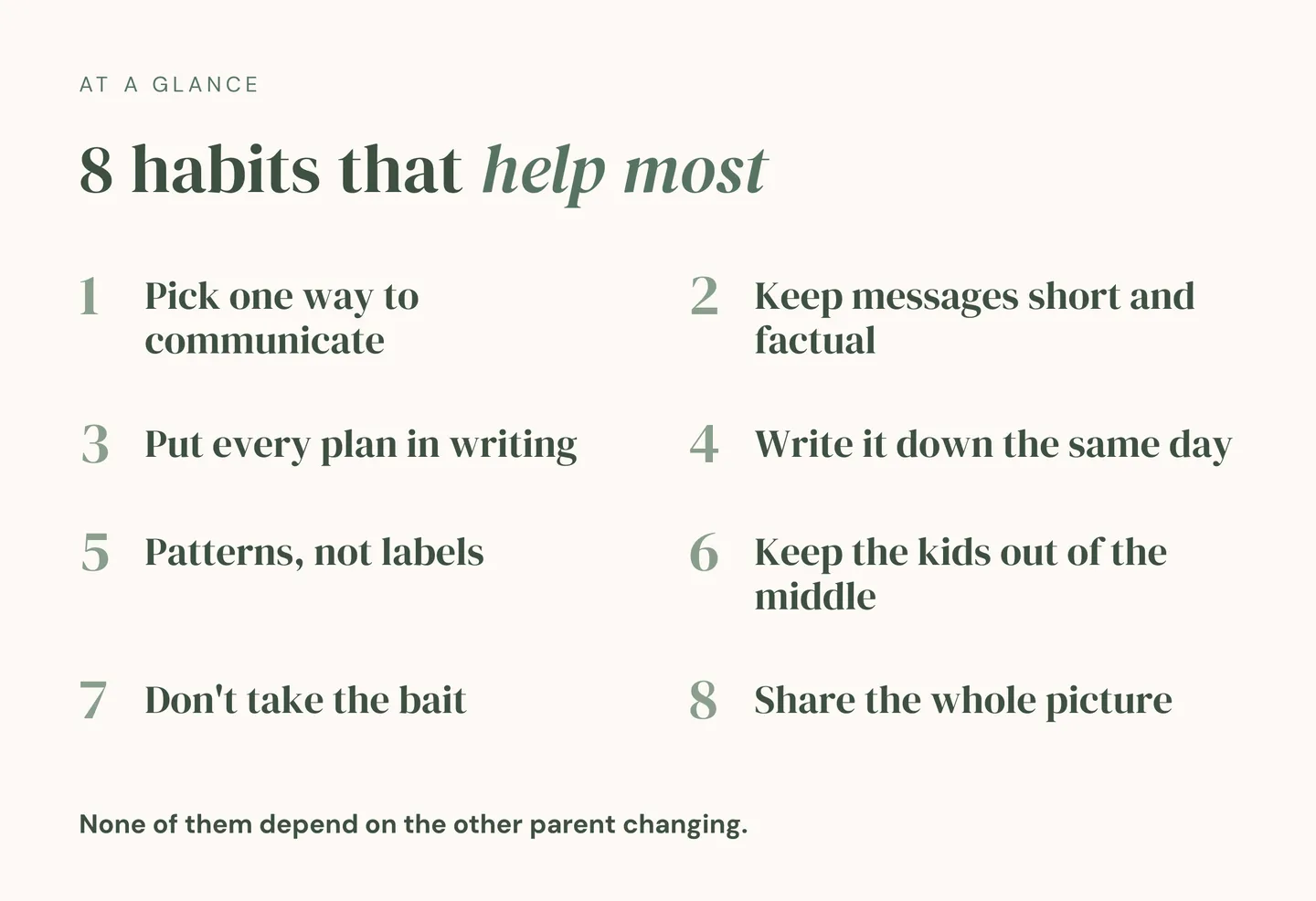
- 1. Pick one way to communicate
- 2. Keep messages short and factual
- 3. Put every plan in writing
- 4. Write it down the same day
- 5. Patterns, not labels
- 6. Keep the kids out of the middle
- 7. Don't take the bait
- 8. Bring the whole picture to the people helping you
- Look after yourself
- Questions parents ask
- Try Clarity Witness
When the story keeps changing, it's easy to start doubting yourself. Plans move at the last minute, conversations get remembered differently, and a simple question about pickup turns into an argument about something else entirely.
We use the word "narcissist" here because it's the word a lot of parents search for. We're not diagnosing anyone - only a professional can do that, and it's not something you need to prove. What matters is the behavior, how it affects you and the kids, and what you can do about it. That's what this guide is about, along with how Clarity Witness can take some of the weight off.
What it often looks like
Every situation is different, but many parents describe the same things:
- Plans that change at short notice, often right before a handover
- Conversations remembered very differently, or denied altogether
- Messages that mix a practical question with a dig or an accusation
- The kids being used to pass messages, or asked about your home
- Rules that seem to apply to you but not to them
- Being made to feel that every problem is your fault
If some of that sounds familiar, the habits below help most. None of them depend on the other parent changing. They're about what you can control.
1. Pick one way to communicate
Texts, emails, voicemails, social media, notes in a school bag - when messages come from everywhere, things get lost and it's easy to be caught off guard. Agree on one channel for arrangements and keep to it.
Many parenting plans and court orders now name a co-parenting app for exactly this reason. If you're still agreeing your plan, it's worth proposing one.
In Clarity Witness: there's a co-parenting chat built in. Every message is timestamped, and once it's sent it can't be edited or deleted, so there's only ever one version of what was said. If you're putting together a parenting plan, you can propose Clarity Witness as the app you'll both use.
2. Keep messages short and factual
Reply to the question, not the tone. Time, place, the kids - that's usually all a message needs. Long explanations give the other side more to argue with, and they tend to read badly later.
A simple structure many counselors teach is the BIFF Response®, developed by Bill Eddy at the High Conflict Institute: brief, informative, friendly, firm. For example:
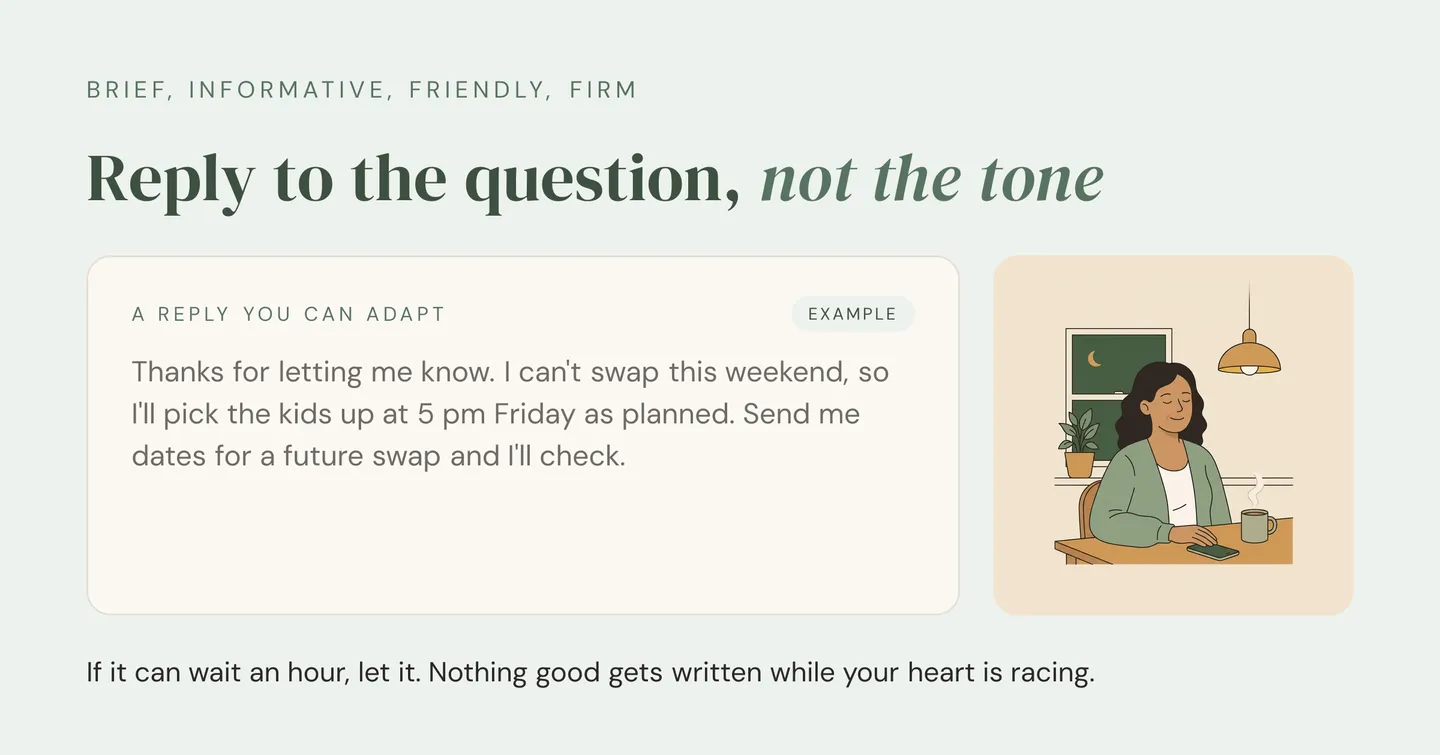
If a message doesn't need an answer, it may not need one today. Waiting an hour before replying is often the best choice you can make. Nothing good gets written while your heart is racing.
In Clarity Witness: before you send, you can run a tone check on your reply to see how it might come across. It takes a few seconds and it's often enough to catch the line you'd regret.
3. Put every plan in writing
Agree times and places in writing, even when you've also talked on the phone or at the door. A one-line confirmation the day before saves a long argument afterwards.
You're not trying to catch anyone out. You're making sure there's one version of the plan that both of you can see.
In Clarity Witness: confirm it in the chat and it's timestamped and kept alongside everything else, so you're not hunting through old texts when the plan is questioned later.
4. Write it down the same day
Memory fades, and it gets questioned. A few dated lines written the same day beat pages written months later.
After a handover, note:
- The time agreed, and the time it actually happened
- Who was there
- What was said, word for word if it matters
- Any last-minute change, and how you heard about it
- How the kids seemed, as facts rather than guesses
Leave out guesses about motives and anything you heard second-hand. And don't question the kids for information. If they tell you something, write it down in their words and leave it there.
In Clarity Witness: the quick log on your Today page is built for this. Write a few lines from your phone, and the entry is dated for you and linked to the people involved. Your record is private: nobody else sees it unless you choose to share it.
5. Patterns, not labels
Whatever you believe about the other parent, the people helping you (an attorney, a mediator, a guardian ad litem) usually respond better to facts than to labels. A label invites an argument about whether it's fair. A pattern is hard to argue with.
Compare these two:
- "She's controlling and does whatever she wants."
- "The handover time has changed four times in six weeks, each time the evening before."
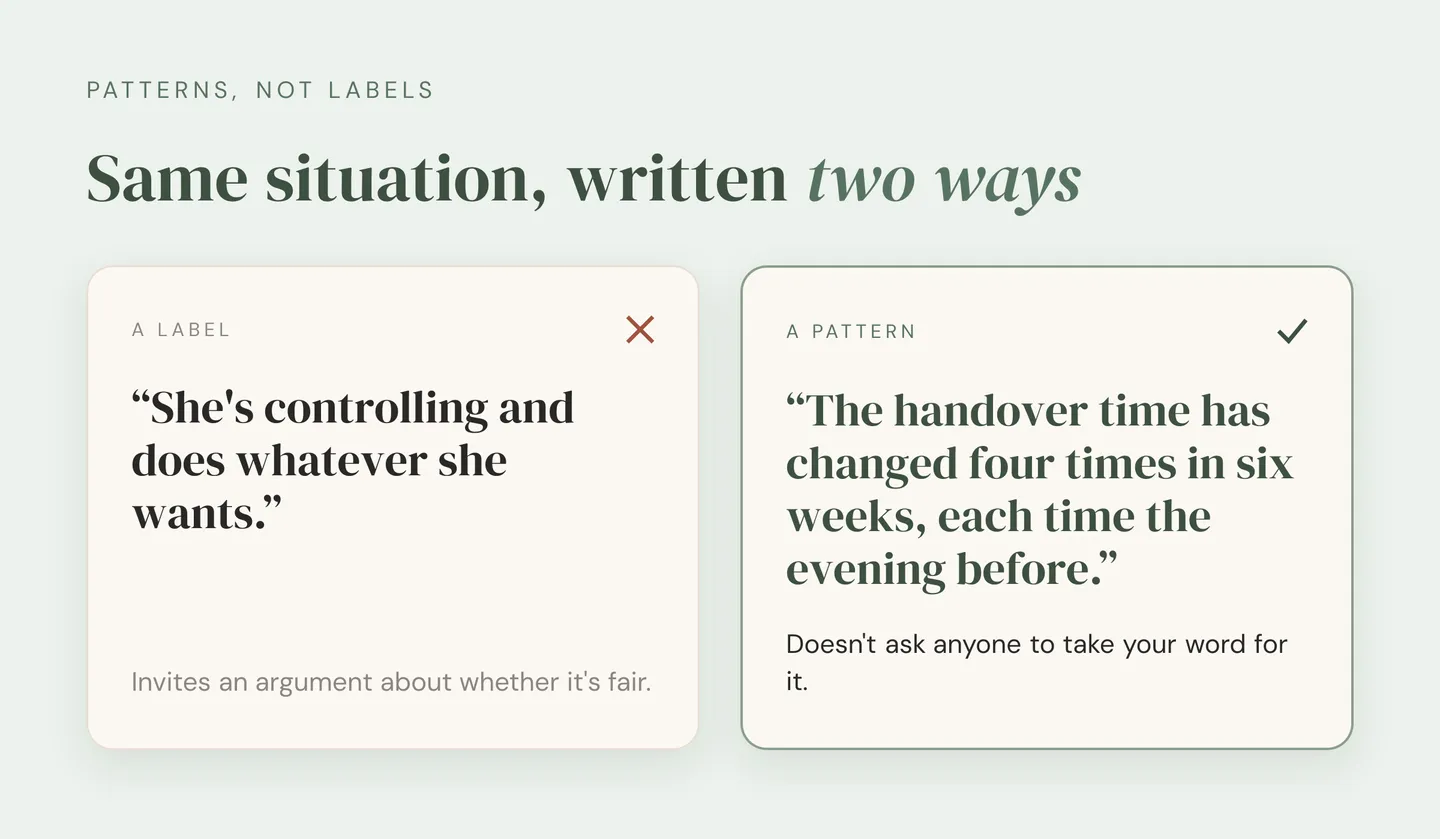
The second one says more, and it doesn't ask anyone to take your word for it. Write what happened, when, and who was involved, and let the pattern speak for itself.
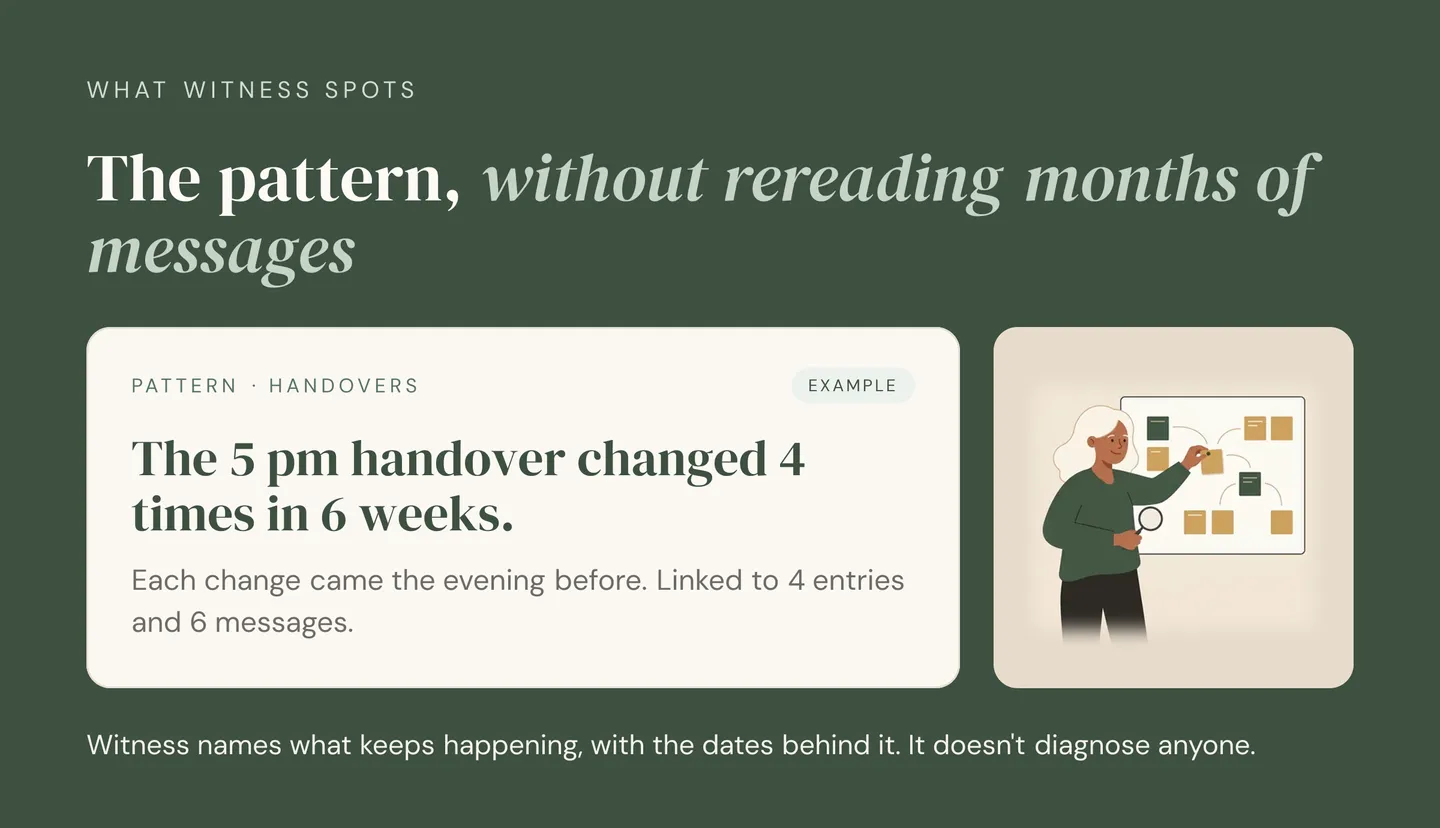
In Clarity Witness: this is what Witness is for. It reads your whole record - entries, messages, the people involved - and points out what keeps happening, with the dates behind it. You get the pattern without having to reread months of messages to find it.
6. Keep the kids out of the middle
This is the hardest one, and the one that matters most. Kids do best when they're free to love both parents, even when the adults can't get along.
- Don't send messages through the kids, even small ones
- Don't criticize the other parent in front of them, or where they might overhear
- Don't ask them to keep secrets, or to report back on the other home
- If they repeat something hurtful the other parent said, don't react in front of them. Something like "That's a grown-up thing for me to sort out - you don't need to worry about it" is enough
If you're worried about how the kids are coping, a family counselor or their school counselor is a good place to start.
In Clarity Witness: when every arrangement lives in one chat between the adults, there's no reason for anything to go through the kids. If the kids are put in the middle anyway, note it on the day so it's part of the record.
7. Don't take the bait
Some messages are written to get a reaction. You don't have to defend yourself, correct every claim, or win the argument. Answer the practical part, if there is one, and ignore the rest.
This is sometimes called the grey rock approach: polite, brief and uninteresting, with nothing to push against. It can feel unnatural at first, especially when something said about you isn't true. It does get easier, and over time there's often less to respond to.
In Clarity Witness: instead of arguing back, log it. A short entry on your timeline puts the claim on record without starting another round, and the people helping you can deal with it properly.
8. Bring the whole picture to the people helping you
Attorneys bill by the hour, and reading through months of screenshots is slow and expensive. A clear, dated summary saves time and helps them see what you see.
It's also worth asking whether parallel parenting might help. It's an arrangement where each parent runs their own home with very little direct contact, and communication is kept to the essentials. Your attorney or mediator can tell you whether it fits your situation.
Coming soon in Clarity Witness: briefings will turn your record into a clear, dated summary you can share with your attorney or mediator. Instead of a folder of screenshots, they'll get the whole picture in a few pages.
Look after yourself
This is a long game. Find someone to talk to: a counselor, a support group, or a friend who'll listen without stirring things up. Sleep, eat properly, and take breaks from your phone. A rested you makes better decisions, and the kids notice.
Questions parents ask
Should I call them a narcissist when I talk to my attorney or a mediator? It's better not to. Describe what happened instead, with dates. Labels can make you look like the one escalating, even when you're not.
Do I have to reply to every message? No. Reply to what needs a reply, usually anything about the kids' schedule, health or school. Messages that only criticize or provoke can often be left alone.
What if they deny something I know happened? Don't argue it by text. Your same-day notes are what count. Write down the denial too, and carry on. If the original was a message in the Clarity Witness chat, it's still there exactly as it was sent.
Is it worth keeping a record if nothing is going to court? Yes. A record helps you see what's really happening, plan better, and stop second-guessing yourself. If things do change later, you'll be glad you started early.